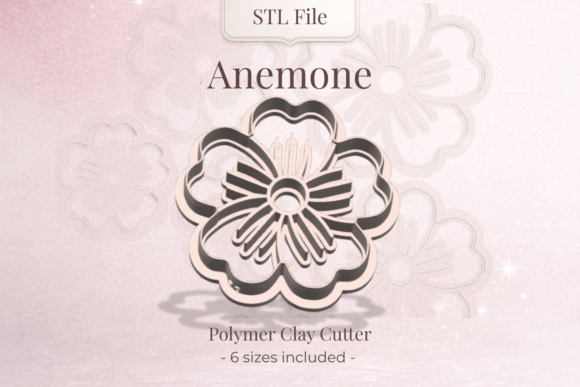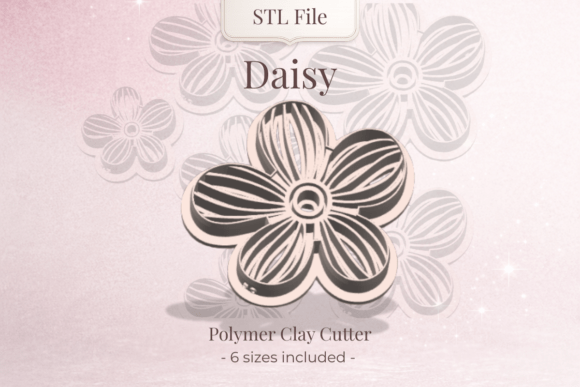
Clay Cutter STL – Daisy Flower: Precision Craftsmanship for the Modern Maker
The landscape of handmade jewelry has shifted dramatically in recent years, moving from a reliance on mass-produced tools to a demand for bespoke, customizable equipment. At the forefront of this evolution is the Clay Cutter STL – Daisy Flower, a digital design that empowers polymer clay artists to create their own high-precision cutting tools. This file represents more than just a shape; it is a bridge between digital design and tactile artistry, allowing creators to produce consistent, professional-grade floral elements directly in their home studios. For hobbyists and business owners alike, the ability to 3D print custom cutters transforms the workflow of making polymer clay earrings and other floral jewelry pieces.
The Shift Toward Customizable Digital Tools
Traditionally, jewelry makers had to purchase physical cutters from catalogs, often waiting weeks for shipping or settling for designs that did not quite match their vision. The market was limited by what manufacturers chose to stock. Today, the rise of accessible FDM 3D printing technology has democratized tool creation. The Daisy flower cutter design, created by S.I. Originals, exemplifies this change. It allows users to bypass supply chain delays and inventory limitations by downloading a file and printing the exact tool they need, exactly when they need it.
This shift aligns with broader trends in the creative economy where flexibility and speed are paramount. Entrepreneurs running small creative studios can now expand their product lines without significant upfront capital investment in molds. Instead of buying six different sizes of daisy cutters at full retail price, an artist can download one STL file and print multiple variations tailored to specific project requirements. This agility supports a "just-in-time" manufacturing model even at the individual creator level, reducing waste and storage costs while maximizing creative potential.
Understanding the Design Specifications
The effectiveness of any clay cutter relies heavily on its geometry and material integrity. The Clay Cutter STL – Daisy Flower is engineered with specific parameters to ensure it performs as well as, if not better than, commercially available metal cutters. The design features a sharp cutting edge and a sturdy wall structure, which are critical for slicing through polymer clay cleanly without dragging or distorting the petals.
One of the most significant advantages of this digital file is the inclusion of multiple size options within a single download. The package provides six distinct cutter sizes:
- 25 mm: Ideal for delicate accents and miniature jewelry components.
- 30 mm: A standard size for everyday earring studs.
- 35 mm: Perfect for statement earrings or central floral motifs.
- 40 mm: Suitable for larger brooches or hair accessories.
- 45 mm: Great for decorative patches on bags or shoes.
- 50 mm: Excellent for large-scale artistic projects or wall decor.
Each of these cutters incorporates a precise 0.4 mm cutting edge. This dimension is not arbitrary; it is optimized to balance durability with sharpness. A thicker edge might be too blunt for soft clay, while a thinner edge could snap under pressure during the printing process or break during use. The 0.4 mm specification ensures that the cutter remains robust enough for repeated use while delivering crisp, clean cuts that define the elegant floral design.
Optimizing Your 3D Printing Workflow
To achieve the best results with the Daisy flower cutter, understanding the printing process is essential. While the design is optimized for standard FDM 3D printers, the choice of material and settings plays a crucial role in the final tool's performance. Most creators find success using PLA (Polylactic Acid) due to its ease of printing and sufficient hardness for cutting soft materials like polymer clay.
However, for those who plan to use their cutters extensively in a commercial setting, considering PETG or even TPU (Thermoplastic Polyurethane) might offer increased durability and resistance to wear over time. When slicing the STL file, attention should be paid to the infill density. A higher infill percentage, typically between 80% and 100%, is recommended for the cutting walls to ensure there are no weak points that could deform under the pressure of cutting.
Furthermore, the orientation of the print matters. Printing the cutter standing upright rather than flat can help maintain the structural integrity of the thin petals, although this may require support structures depending on the printer's capabilities. The goal is to minimize layer lines on the cutting surface, as these can cause friction and result in uneven edges on the clay. Post-processing, such as light sanding of the cutting edge, can further refine the tool for professional results.
Practical Applications for Jewelry Makers
The versatility of the Clay Cutter STL – Daisy Flower extends beyond simple replication. Artists can use these cutters to build complex floral arrangements, creating depth and texture by layering different sizes. For instance, a 30 mm daisy can serve as the base, with a 25 mm daisy layered on top in a contrasting color to create a dimensional effect. This technique is highly popular in modern polymer clay jewelry, where intricate details and mixed media approaches are valued.
For educators and workshop leaders, this digital file offers a unique opportunity to teach students about both traditional crafting and modern fabrication. Classes can cover the history of floral motifs in jewelry, the chemistry of polymer clay, and the mechanics of 3D printing all in one session. Students learn to appreciate the intersection of analog and digital skills, preparing them for a future where hybrid workflows are the norm.
Business owners can also leverage this tool to test new designs before committing to expensive metal molds. By printing a batch of cutters, a studio can gauge customer interest in a specific floral style. If the daisy design sells well, the business can scale up production confidently. If the market response is lukewarm, the cost of failure is minimal, limited only to the filament used for printing. This low-risk approach encourages experimentation and innovation, driving the creative industry forward.
Why Consistency Matters in Handmade Markets
In the competitive world of handmade goods, consistency is often the differentiator between a hobbyist and a professional brand. Customers purchasing jewelry online expect uniformity in size and shape, especially when buying matching sets. Hand-cutting shapes with knives or improvised tools often leads to slight variations that can detract from the perceived quality of the finished product. The Daisy flower cutter eliminates this variable.
By using a 3D printed cutter derived from a precise digital file, every piece of clay cut is identical. This reliability allows artisans to focus their energy on coloring, texturing, and assembling their pieces rather than struggling to get the basic shape right. It elevates the overall quality of the work, ensuring that the final product meets the high standards expected by today's discerning consumers. Moreover, the ability to reproduce exact shapes means that broken or lost pieces can be easily replaced, maintaining the integrity of a collection.
Future-Proofing Your Creative Studio
As technology continues to advance, the line between digital files and physical objects will become increasingly blurred. The adoption of tools like the Clay Cutter STL – Daisy Flower is a step toward future-proofing a creative practice. It positions the maker at the intersection of craftsmanship and innovation, ready to adapt to new trends and technologies as they emerge.
Whether you are a seasoned professional looking to streamline your production or a curious beginner eager to explore the possibilities of 3D printing, this design offers a practical and elegant solution. It embodies the spirit of the modern maker: resourceful, innovative, and dedicated to quality. By integrating this digital asset into your toolkit, you are not just acquiring a cutter; you are embracing a new way of creating that is efficient, sustainable, and endlessly inspiring.