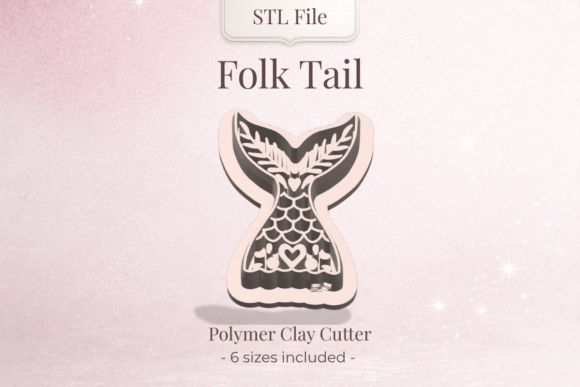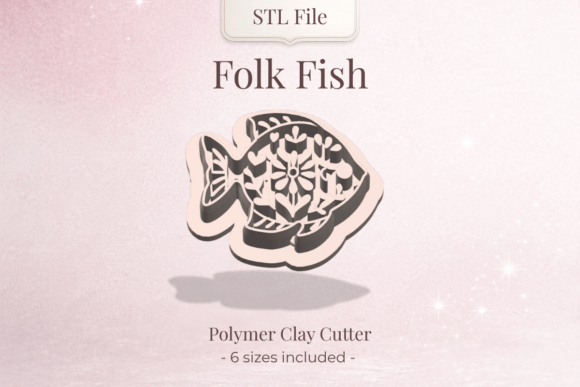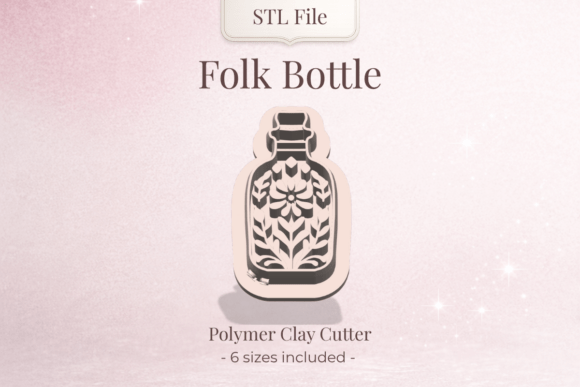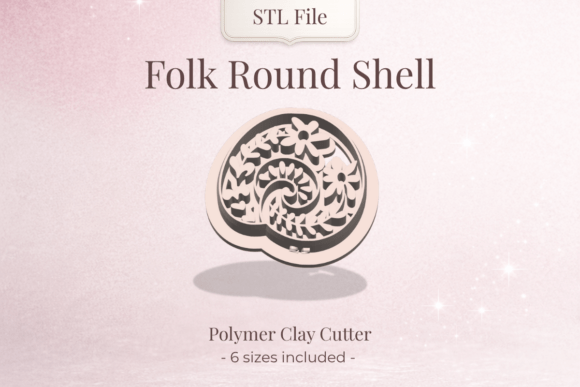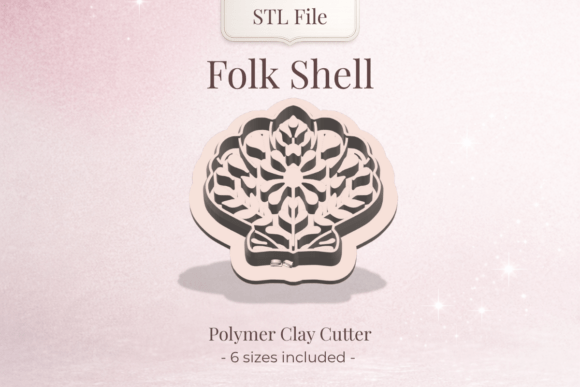
Clay Cutter STL – Folk Shell Jewelry
For polymer clay artists and jewelry makers, the difference between a good piece and a great one often lies in consistency. Hand-cutting intricate floral shapes can be time-consuming and prone to uneven edges, which is why digital tools have become essential in modern crafting studios. The Clay Cutter STL – Folk Shell Jewelry represents a bridge between traditional artisan techniques and the precision of additive manufacturing. Designed by S.I. Originals, this digital file allows creators to 3D print their own high-quality cutting tool, tailored specifically for producing elegant flower-shaped components for earrings and other accessories.
This is not merely a download; it is a production asset. By utilizing a standard FDM 3D printer, you can transform a simple PLA filament into a durable, sharp-edged cutter that ensures every slice of polymer clay is clean and uniform. The Folk Shell design captures the delicate layers of a blooming flower, offering a sophisticated aesthetic that elevates handmade jewelry from casual craft to professional wearable art. Whether you are a hobbyist looking to expand your toolkit or a small business owner aiming to streamline your workflow, understanding how to leverage this STL file can significantly enhance your creative output.
The Precision of Digital Tooling for Clay Art
Traditional metal cutters are excellent, but they are fixed in size and shape. Once purchased, you are limited to the specific dimensions offered by the manufacturer. The Clay Cutter STL – Folk Shell Jewelry changes this dynamic entirely. Because the tool is generated from a digital file, you have the freedom to produce multiple sizes instantly without waiting for shipping or paying premium prices for individual molds. The listing includes six distinct sizes ranging from 25 mm to 50 mm, covering a spectrum from petite studs to statement earrings.
The engineering behind this design focuses on two critical factors: wall thickness and edge sharpness. A 0.4 mm cutting edge is integrated directly into the model, providing the necessary thinness to slice through conditioned polymer clay without dragging or tearing. This precision is vital when working with soft clays like Fimo Soft or Premo! Sculpey, where excessive pressure can distort the shape before it is baked. Furthermore, the sturdy walls of the cutter ensure that the tool does not flex under pressure, maintaining the integrity of the Folk Shell pattern even after hundreds of uses.
Why Size Variety Matters in Jewelry Design
The inclusion of six sizes (25 mm, 30 mm, 35 mm, 40 mm, 45 mm, and 50 mm) offers significant creative flexibility. In jewelry making, scale dictates the impact of a piece. A 25 mm flower might serve as a subtle accent on a pair of minimalist hoop earrings, while a 50 mm version could be the centerpiece of a bold, sculptural brooch or a chandelier earring drop. Having access to this full range within a single project allows designers to create matching sets with varying proportions, adding visual interest and depth to a collection.
Consider the concept of asymmetry. Many contemporary jewelry trends favor mismatched pairs. With the Folk Shell cutter set, you can easily create a pair of earrings where one features a 35 mm bloom and the other a 45 mm bloom, perhaps layered with different colors or textures. This approach requires no additional investment in new tools, only the ability to print the specific size needed for the day's project. It encourages experimentation with scale, allowing artists to test how the same motif looks at different magnifications before committing to a final batch production.
Optimizing Your 3D Printing Workflow
To get the most out of the Clay Cutter STL – Folk Shell Jewelry, proper printing settings are non-negotiable. While the design is optimized for FDM printers, the material choice plays a pivotal role in performance. PLA is the recommended material due to its rigidity and ease of printing. Unlike flexible filaments such as TPU, PLA maintains a hard, crisp edge that resists bending during the cutting process. However, because PLA can be brittle if subjected to extreme lateral force, users should handle the cutters with care, applying downward pressure rather than twisting motions.
When slicing the model for print, attention to layer height and infill is crucial. A lower layer height, such as 0.12 mm or 0.16 mm, will result in a smoother surface finish on the cutting edge, reducing friction against the clay. For the internal structure, a higher infill percentage—ideally 100% or close to it—is advisable. Since these are solid functional tools rather than decorative models, there is no need to save on material. A fully dense cutter ensures maximum durability and prevents the tool from snapping under the stress of repeated use.
Orientation on the build plate also matters. Printing the cutter standing upright usually yields the best results for the cutting edge, as it minimizes the number of layers intersecting the blade itself. If the edge is printed horizontally, the layer lines may create micro-grooves that catch on the clay. By orienting the model vertically, the cutting edge becomes a continuous line of extrusion, resulting in a cleaner, more effective slice. Always support the overhangs of the Folk Shell petals adequately to prevent warping, ensuring the final geometry matches the digital design perfectly.
Creative Applications and Stylistic Variations
Once you have your printed Folk Shell cutters, the possibilities for artistic interpretation are vast. The basic flower shape serves as a canvas for various polymer clay techniques. You can use the cutters to create solid blooms, but the true potential lies in layering. By stacking sheets of translucent clay in gradient colors before cutting, you can achieve a "shell" effect that mimics the natural translucency of real petals. This technique works particularly well with the Folk Shell design, as its layered petal structure enhances the light refraction once baked.
Beyond simple coloring, the cutters can be used to create mixed-media pieces. Imagine cutting the flowers from metallic clay and then embedding them into resin pendants, or using them as molds for casting wax seals for packaging your finished jewelry. The consistent shape allows for mass production of components, which is ideal for entrepreneurs running Etsy shops or local market stalls. Consistency is key to branding; customers expect every piece in a collection to look identical, and the mechanical precision of a 3D-printed cutter guarantees this uniformity far better than hand-cutting ever could.
Adapting for Different Audiences and Markets
Different target audiences respond to different scales and finishes. For a youthful, bohemian market, you might focus on the smaller 25 mm and 30 mm sizes, pairing them with bright, contrasting colors and playful chains. Conversely, for a luxury or bridal market, the larger 45 mm and 50 mm sizes allow for more intricate detailing. You can texture the clay before cutting, add mica powders for shimmer, or incorporate gold leaf accents. The Folk Shell cutter provides the structural foundation, but the artist's touch defines the final style.
Educators and workshop leaders can also benefit immensely from this resource. Teaching students how to make consistent shapes is often challenging. Providing them with pre-printed Folk Shell cutters removes the frustration of uneven cuts, allowing them to focus on color theory, baking techniques, and finishing skills. It democratizes the creation of professional-looking jewelry, giving beginners the confidence to produce work that rivals experienced artisans.
Maintaining Quality and Longevity
To ensure your Clay Cutter STL – Folk Shell Jewelry remains effective over time, proper maintenance is essential. After each use, clean the cutter thoroughly with a dry brush or a damp cloth to remove any residual clay. Polymer clay can harden if left on the tool, potentially dulling the sharp 0.4 mm edge. Avoid using harsh chemicals or abrasive scrubbers that could degrade the PLA surface. Store the cutters in a protective case or drawer to prevent accidental drops, as PLA can crack if struck against a hard surface.
If a cutter does eventually wear down or break, the beauty of the digital format is that replacement is instantaneous. You simply reload the STL file and print a new one. This reduces waste and eliminates the cost of buying expensive metal replacements. It empowers creators to iterate and improve their tools as needed, fostering a sustainable and efficient workflow. By integrating this digital solution into your studio, you are not just acquiring a tool; you are adopting a smarter, more flexible approach to creative production.